
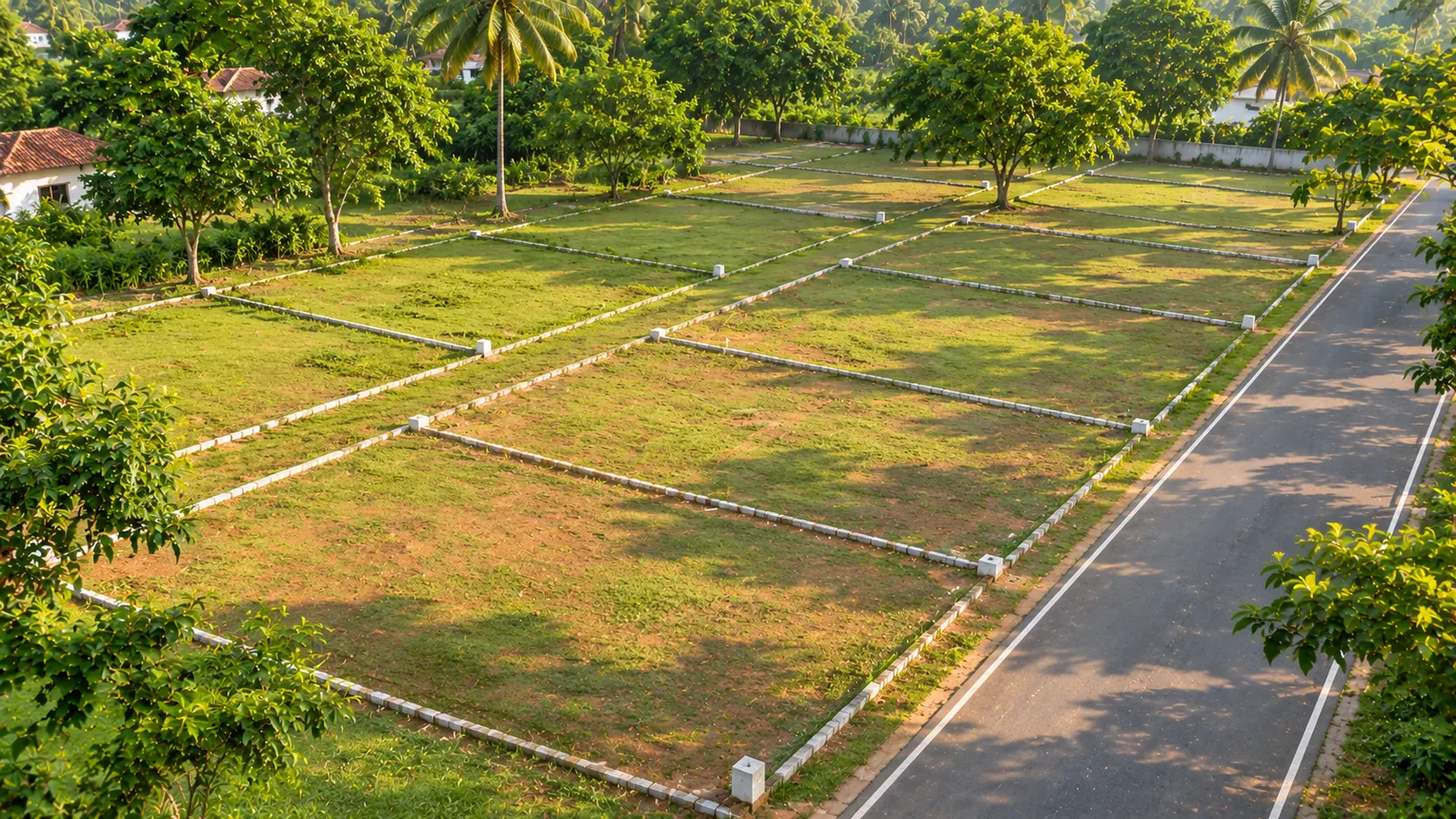
Shape of the plot
A square plot (chaturasra) is the best, as all the texts agree. A rectangle is good when its length is not more than about twice its breadth; longer plots are counted poor. Circular, triangular and many-sided plots are avoided for houses.
- Gomukhi (cow-faced): narrower at the front, wider at the back. Good for homes in South Indian practice.
- Simhamukhi (lion-faced): wider at the front, narrower at the back. Suited to shops and business, not to homes.
- Extended corners: an extension towards the north-east is good. Extensions at the other corners, above all the south-west and south-east, are faults.
- Cut corners: a cut north-east is the most serious shape fault; cuts at the other corners are lesser faults.
- Irregular plots: square them off with a compound wall and build the house on the square part. The leftover piece can be a garden.
Plot shapes at a glance
- Square✓ Good
- Rectangle up to 1 : 2✓ Good
- Longer than 1 : 2✕ Avoid
- Gomukhi (narrow front)✓ Good
- Simhamukhi (wide front)◐ Shops only
- North-east extended✓ Good
- North-east cut✕ Avoid
- South-west extended✕ Avoid
- Triangle / irregular✕ Avoid
- ▲ North is at the top
- Road
Slope of the land
Brihat Samhita and the regional traditions all praise land that slopes down towards the north, the east and the north-east, so that rainwater leaves by the north-east. Land sloping to the south, the west or the south-west is not favoured; it is levelled or built up before building.
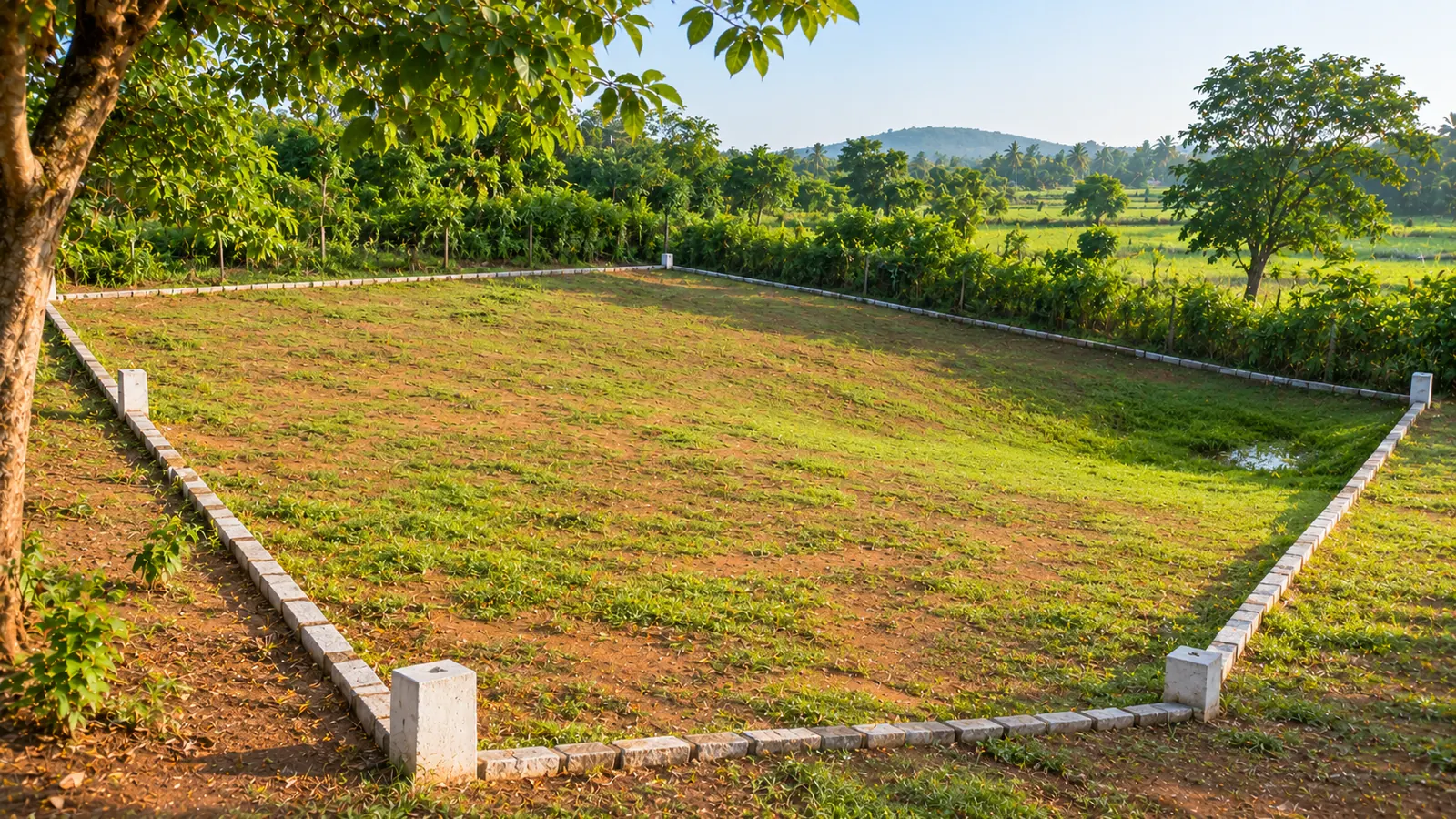
Roads around the plot
- A road on the east or north is the most favoured.
- Roads on the north and east together (a north-east corner plot) are the most praised corner.
- Roads on all four sides are considered good in many traditions.
- A plot with a road only on the south or west is not bad; place the door in the good padas of that side and leave open land on the north and east inside the plot.
Veedhi shoola: a road hitting the plot
When a road runs straight into the plot and ends there (a T-junction), its 'thrust' falls on that part of the plot. The Telugu tradition reads it by the half of the side it hits. Four positions are counted good: the north-east half from the east or the north, the south-east half from the south, and the north-west half from the west. Four are counted bad: the south-east half from the east, the south-west half from the south or the west, and the north-west half from the north.
The classical texts know this as a kind of vedha (obstruction) of the house and its door. Where a bad veedhi shoola cannot be avoided, a solid compound wall, and keeping the door well away from the point of impact, is the usual correction.
Veedhi shoola: roads that hit the plot
A road that runs straight into the plot. Four positions are counted good, four are not.
- 1 East Road → North-east: ✓ Good road hit
- 2 North Road → North-east: ✓ Good road hit
- 3 South Road → South-east: ✓ Good road hit
- 4 West Road → North-west: ✓ Good road hit
- 5 East Road → South-east: ✕ Road hit to avoid
- 6 South Road → South-west: ✕ Road hit to avoid
- 7 West Road → South-west: ✕ Road hit to avoid
- 8 North Road → North-west: ✕ Road hit to avoid
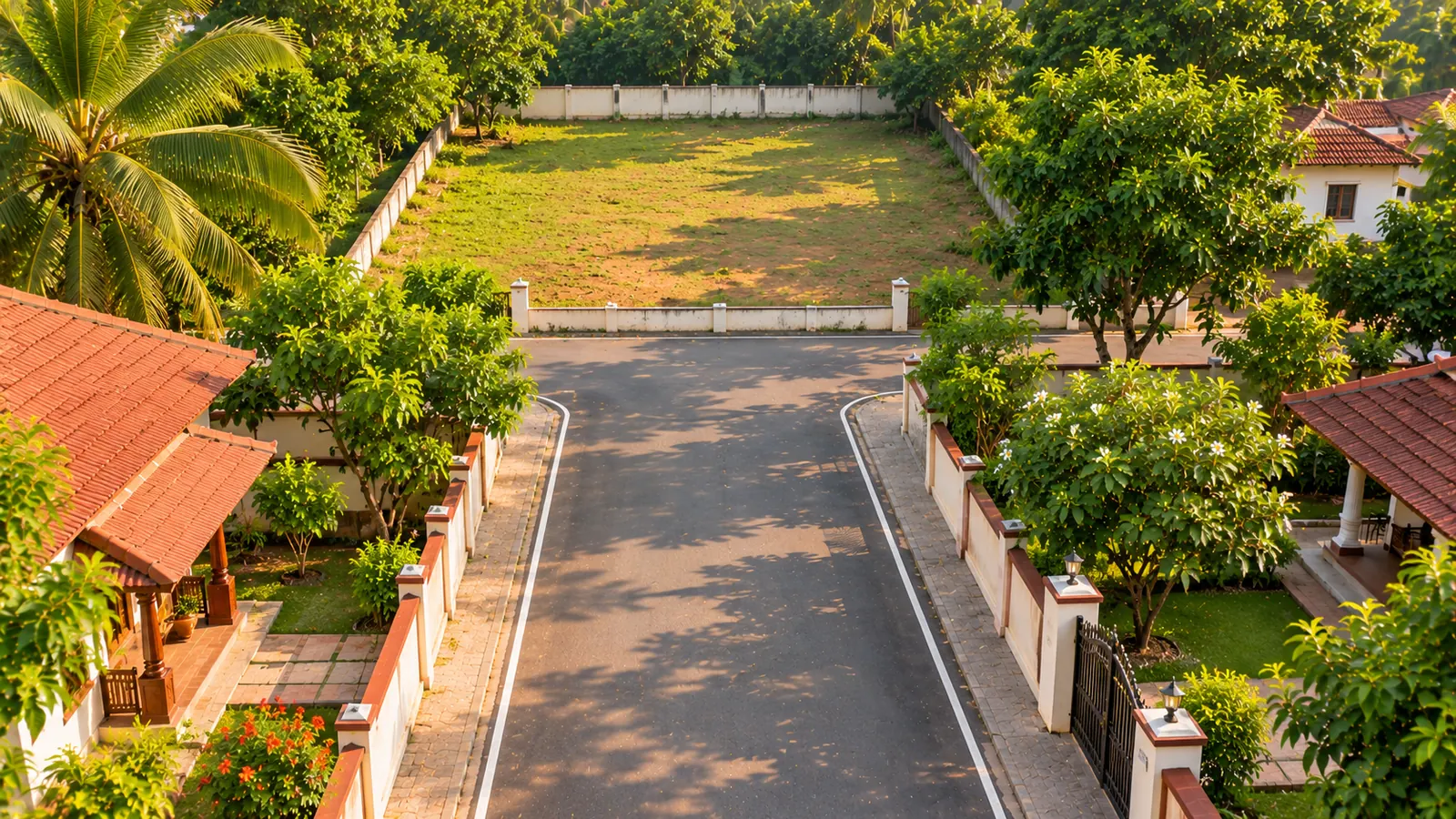
Surroundings
- Brihat Samhita advises against thorny trees and trees with milky sap close to the house; large trees are better on the south and west, away from the walls.
- The shadow of a temple tower, or a house directly opposite a temple door, is avoided in common practice.
- Avoid plots on filled tanks, burial grounds or ant-hills; the texts test the soil precisely to find such land.
- Higher land or tall buildings to the south and west are good; to the north and east they are not.
- Water bodies (a lake, a canal) to the north or east are good; to the south or west they are not.
Soil tests from the texts
Brihat Samhita and Mayamatam both describe how to test the soil before building. These are simple, practical tests that anyone can still do:
- Pit and refill: dig a pit about one cubit (a forearm's length) deep and wide, and put the soil back. If soil is left over, the land is excellent; if it just fills, average; if the pit is not filled, poor.
- Water: fill the pit with water and walk a hundred steps away and back. If the water has hardly gone down, the land is good; if it has drained away quickly, the land is not.
- Colour, smell and taste: the texts describe good soil as of even colour, pleasant smell and sweet taste, without bones, charcoal, husk, ant-hills or rubbish.
- Seeds: the texts also describe sowing seeds in the plot and watching how quickly they sprout; quick, healthy growth marks good land.
The texts tie soil colours to the four varnas. Today these tests are read simply as tests of soil quality, drainage and firmness, which is exactly what they measure.