
Home › Vastu Shastra › Rooms › Main door

Vastu for the main door (simha dwaram)

The main door is the mouth of the house. The texts place it by padas on the side it faces, keep it the largest door, and keep the space in front of it clear.

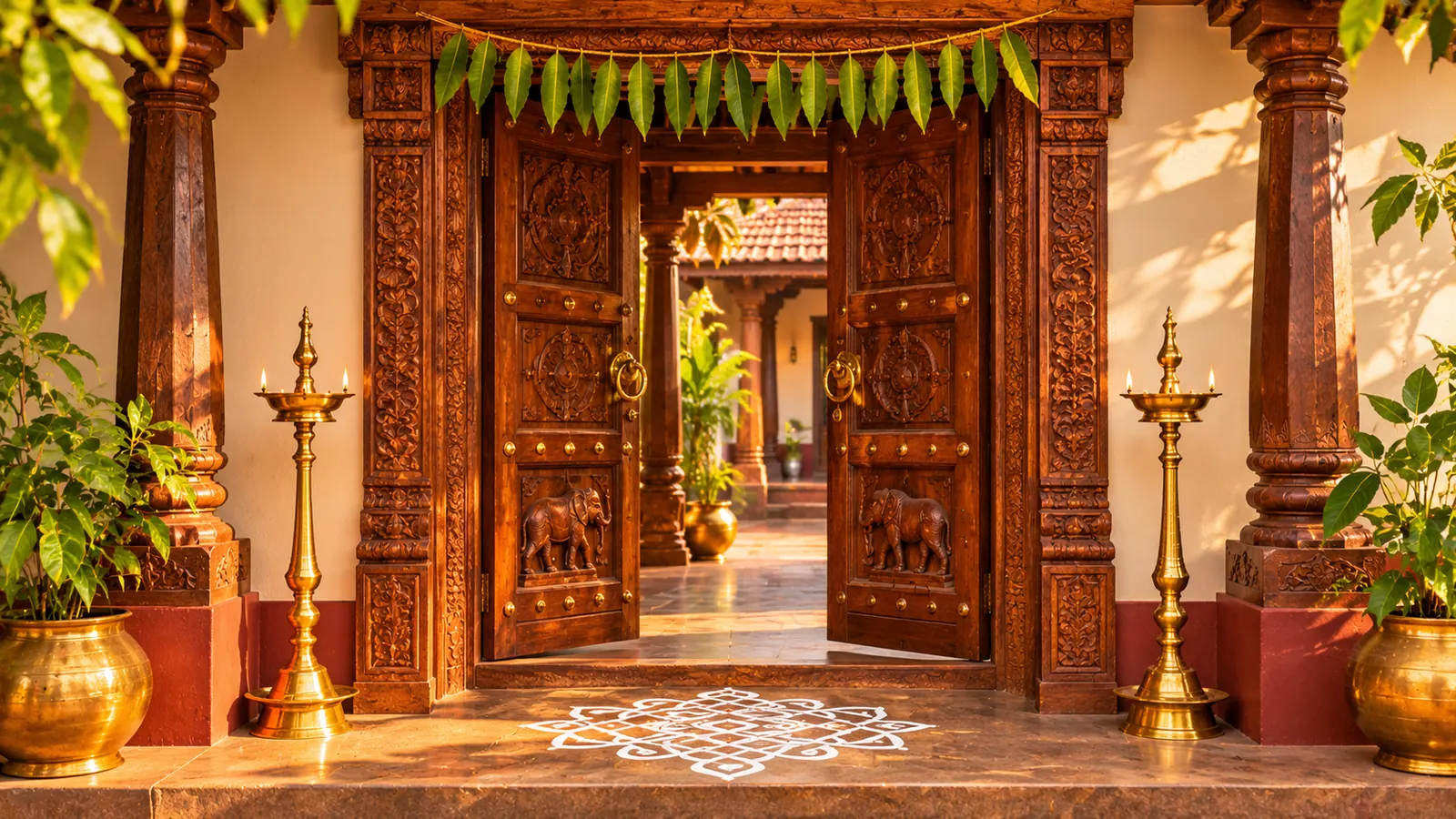
A carved wooden double main door with a turmeric-marked threshold and a rangoli in front
A well-placed main door, its threshold marked with turmeric.

Main door: where it goes

The house divided into nine zones, north at the top.

Main door: where it goes

Main door: where it goes: North Ideal, North-east Acceptable, West Acceptable, East Ideal, South-west Avoid, South AcceptableNorth-west–North✓IdealNorth-east◐AcceptableWest◐AcceptableCentre–East✓IdealSouth-west✕AvoidSouth◐AcceptableSouth-east–NSEW
  • Ideal
  • Acceptable
  • Avoid
  • Depends / no rule
  • North is at the top
✓ IdealOn the east and north sides, in the auspicious padas (towards the north-east half): the favoured sides for light and open space.
◐ AcceptableOn the south and west sides too, when the door is in their auspicious padas. Close to the north-east corner is fine, but not in the corner itself.
✕ AvoidThe south-west: the heaviest, most closed corner of the house, where a door is counted a serious fault in every tradition.

The door padas

Each side of the house has 8 door padas from the outer ring of the mandala. Brihat Samhita gives a result for each of the 32 doors. Most lists read these as auspicious: Jayanta and Indra on the east; Vitatha and Grihakshata on the south; Sugriva and Pushpadanta on the west; Mukhya, Bhallata and Soma on the north. Some lists also accept Surya and Satya on the east and Varuna on the west.

The lists are not identical between texts, especially for the padas next to the good ones, so treat the middle of the good padas as the safe position.

The 32 door padas

The outer ring of the mandala, 8 padas on each side. Green: padas most texts read as auspicious for the main door; amber: accepted in some lists.

The 32 door padas: East: Jayanta, Indra; South: Vitatha, Grihakshata; West: Sugriva, Pushpadanta; North: Mukhya, Bhallata, SomaHouse1Isha2Parjanya3Jayanta4Indra5Surya6Satya7Bhrisha8Antariksha9Agni10Pusha11Vitatha12Grihakshata13Yama14Gandharva15Bhringaraja16Mriga17Pitru18Dauvarika19Sugriva20Pushpadanta21Varuna22Asura23Shosha24Papayakshma25Roga26Naga27Mukhya28Bhallata29Soma30Bhujaga31Aditi32DitiNorthSouthEastWest
  • Auspicious door pada
  • Accepted in some lists
  • Other padas

East: 1 Isha2 Parjanya3 Jayanta4 Indra5 Surya6 Satya7 Bhrisha8 Antariksha

South: 9 Agni10 Pusha11 Vitatha12 Grihakshata13 Yama14 Gandharva15 Bhringaraja16 Mriga

West: 17 Pitru18 Dauvarika19 Sugriva20 Pushpadanta21 Varuna22 Asura23 Shosha24 Papayakshma

North: 25 Roga26 Naga27 Mukhya28 Bhallata29 Soma30 Bhujaga31 Aditi32 Diti

Uccha and neecha: the Telugu rule

Telugu builders follow a simpler rule: divide each side into two halves. The half towards the north-east (on the east and north sides), towards the south-east (on the south side) and towards the north-west (on the west side) is uccha, exalted; the other half is neecha. The door should be in the uccha half.

On the east and north this agrees with the padas. On the south the good padas also lie in the south-east half. On the west the padas Sugriva and Pushpadanta lie in the south-west half, while the Telugu rule prefers the north-west half: here the two traditions really differ. Many purohits resolve it by keeping the west door near the middle, or following the family's own tradition.

The door itself

  • Make the main door the largest and finest door of the house, preferably of good wood, with two shutters.
  • It should open inwards, smoothly and without noise.
  • Keep a proper threshold (gadapa). In Telugu homes it is washed, marked with turmeric and kumkum, and a muggu is drawn before it.
  • Do not place the main door exactly in a corner of the house.
  • Avoid a door that opens straight into a toilet or straight onto the back door in one line.

Dwara vedha: what must not block the door

Brihat Samhita lists obstructions in front of the main door that count as dwara vedha: a tree, a pole or pillar, a well, a drain, the corner of another building, or a road running straight at the door. As the rule is commonly quoted, an obstruction further away than twice the height of the house does not count. A public road between the door and the obstruction also breaks the vedha in common practice.
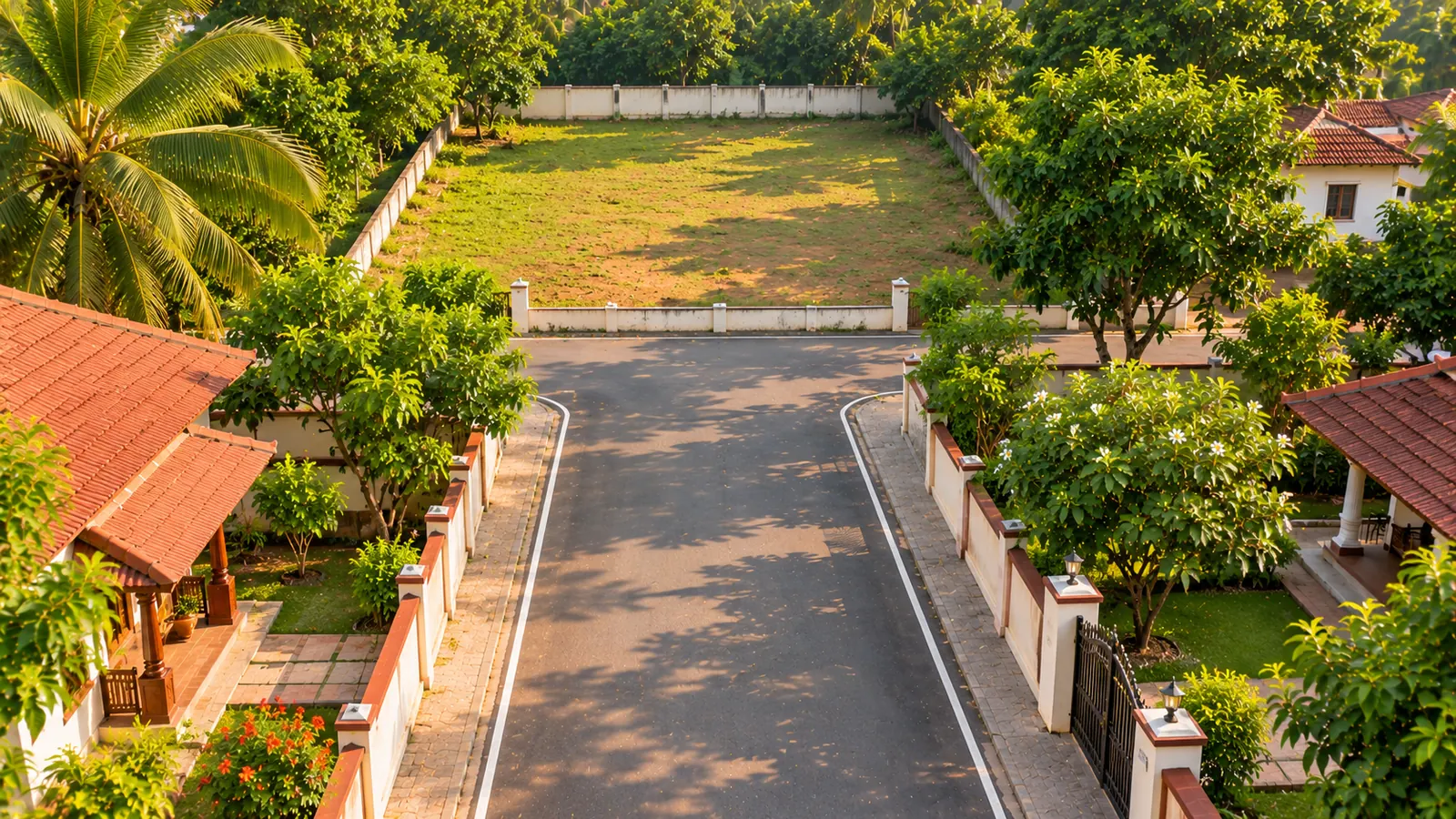
A road running straight towards the front of a house, seen from above
A road aimed at the door is the most common dwara vedha.

✓ Do

  • Put the door in an auspicious pada of its side.
  • Keep the door the largest in the house, opening inwards.
  • Keep the threshold clean and the entrance well lit.
  • Keep the space in front of the door clear.

✕ Avoid

  • A main door in the south-west.
  • A door exactly in a corner.
  • A pole, tree or building corner in line with the door.
  • The main door, an inner door and the back door all in one straight line.

Questions people ask

What if my main door is in a bad pada?

If the frame can be shifted within the same wall to a good pada, that is the real correction. If not, keep the entrance bright and clean, avoid any blockage in front, and perform Vastu shanti. A south-west door is the one case where shifting the door is strongly advised.

Should the main door face east only?

No. Every side has auspicious padas. A west or south door in the right pada is better than an east door in a poor pada.

Can the compound gate be in a different place from the main door?

Yes. The gate is placed by the same pada rules on the compound wall. It need not be in line with the main door; both should be in good padas.

Send us your feedback

Tell us what to improve, what is wrong, or what you liked. We read every message.

About
How useful is Sankh for you? (optional)